Before joining Crick, I was an elementary school teacher for eight years. If there's one thing I learned, it’s that no two schools approach guided reading in quite the same way.
When planning training at Crick, I often find resources and ideas that would have been invaluable in guided reading sessions. So, I thought I’d share some of them with you. I'll also share some practical ways Clicker can support guided reading across different grades, topics, and learner needs.
LearningGrids, our bank of ready-made resources, includes nearly 800 Clicker Books. With fiction and nonfiction texts spanning different curriculum areas, these speech-supported books help students access material beyond their independent reading level.


You could use these books as a whole class teaching tool by introducing and sharing the book on your interactive whiteboard, reading the text all together. Students can then revisit the book independently. They can either read it themselves or use the built-in speech support to listen along, reinforcing understanding and building confidence.
Our books are available at a range of levels, making them a useful tool for adaptive teaching.
These different book types enable students to access the same content as their peers, but at their reading level.
Clicker Books are a great way to familiarize students with traditional tales and myths, and legends. You can explore the Story Corner section of LearningGrids to discover the range of stories we have available.
You can adapt all our resources to meet different reading levels or to link with the topic you are covering. For more information on how to edit or create your own Clicker Book, see our tutorial videos.
Once you’ve introduced a text, the next step might be to encourage students to sequence the story and retell it in their own words, thinking carefully about key features, characteristics, and vocabulary.
Retelling a whole story can be quite a challenge, especially if students have only heard it once or twice. Having the right level of support in place can make a real difference.
A Tell the Story Talk Set supports students with picture prompts to help them recall the key events. They can then record themselves retelling each part, breaking the story down into manageable chunks.

This not only gives the students a safe and supportive space to practice retelling but also provides a useful way to capture evidence of their understanding. The recordings can even be revisited later as a scaffold when students move on to their own written work.
Tell the Story Talk Sets aren’t limited to storytelling either. They can be used to support any sequence of events. For example, instructions for baking a cake or explaining the life cycle of a plant.

Clicker Boards are a great resource for supporting students with sequencing events. The Story Steps resources, for example, work in a similar way to a story mountain activity. Students are given the beginning and ending and then complete the remaining sections with pictures or text to highlight the key events and summarize the story.

You can also print these resources, making it easy to provide students with a physical copy to draw on or annotate with key vocabulary. It’s a ready-made template that can slot straight into your lesson, saving valuable preparation time while still offering meaningful learning opportunities.
In some Clicker Boards, students are given the key events from the story and are challenged to organize them into the correct order. This simple activity is a great way to check understanding of sequencing and narrative structure.
Voice Notes can also be added to a Clicker Board, giving students the opportunity to expand on their ideas or record full sentences alongside their sequencing work.

These activities work well as a whole-class task too! You could invite students to the front of the classroom to rearrange images on the interactive whiteboard, encouraging discussion and collaborative thinking as they justify their choices.
To make studying poetry more interactive, you could use a Listen and Say Talk Set. For example, in the Twinkle, Twinkle Little Star resource, students select the image to hear the poem and can then record themselves reciting it. They can listen back to the poem as many times as they need to and re-record until they are happy with it.

This works particularly well for kindergarten classrooms. Students can listen independently as many times as they need to before recording their own version. You can easily create your own Talk Sets, tailoring them to the specific poem or rhyme you are focusing on.
A Clicker Board can support a student’s recognition of recurring language in stories and poetry. For instance, in a sequencing board, students can match each line of the poem to the corresponding image. Once they’ve ordered the poem correctly, they can add Voice Notes to practice and record their recitation. This helps to reinforce both memory and fluency.

Let’s imagine you’ve read a text, maybe using a Clicker Book, and you’ve spent time picking out the key vocabulary.
The next step might be for students to define those words to deepen their understanding in a traditional “dictionary lesson”… one I used to dread! Students would spend ages locating a word, only to then copy out a definition without really processing what it meant.
Those definitions might end up written in books or displayed on a Working Wall - never to be revisited during the rest of the sequence of lessons.
This is where Connect Sets and Word Banks really come into their own. These writing grids provide the scaffolding students need to engage more meaningfully with vocabulary.
For example, in this Charlotte’s Web Definitions Connect Set, students can select a word from one grid and then match it to the definition.

In the following grid, students are prompted to use that word in a sentence, helping to secure their understanding by applying it in context. The grid contains all the key words and phrases needed, reducing cognitive overload and supporting success.

Word Banks are another useful tool, with the relevant vocabulary organized across tabs. Students can write their own definitions, drawing on the Word Bank to support spelling and word choice as needed. These can be used across both fiction and nonfiction texts, making them a flexible addition to your guided reading toolkit.

Clicker Boards are a great way to keep these definition lessons interactive! Students could match the word to the definition and then use Voice Notes to record a sentence using that word. Bringing a more active, engaging approach to what can otherwise be quite a static task.

If you’d like to create or adapt these resources for your own texts, you can follow our tutorial videos.
Clicker Boards can be a great way to explore what students already know, from their own experiences or from what they have read, and how this can help them understand the text. You could insert an image from the book and students could create a mind map of key vocabulary or ideas, linking them to their own experiences.

A similar approach could be used when making predictions or discussing the significance of the title and events. The Book Cover Detective Clicker Board includes useful prompts to get students thinking carefully about what the title might suggest and what could happen in the story. You can easily adapt this resource to suit your class, simplifying it where needed for younger learners.

When developing inference skills, using what is being said and done, the Character - Outside and Inside Clicker Board provides a clear structure for exploring characterization. Students can gather ideas about a character’s “outside” (appearance, clothing, voice, and behavior) and “inside” (likes, dislikes, personality, and secrets), helping them to build and justify their inferences with evidence.

I remember doing this activity on flipchart paper, drawing a character outline and trying to capture ideas as quickly as possible! Often, I’d rewrite everything at the end of the day so it was clear enough for the Working Wall. With this resource, the template is ready to go, and students can contribute ideas either as a class or independently using the tabs. They can even add Voice Notes to explain how a character is feeling or to justify their interpretations. You could then print the completed board so learners have a copy in their books to refer back to in future writing.
I also really like the Before and After Clicker Boards. They prompt students to use what they already know about a text and what has already happened to predict what might happen next. It’s a simple but effective way to encourage discussion and support creative thinking, while keeping the focus firmly on evidence from the text.

Many learners can talk confidently about what they’ve understood and explain what a text is about. The part they find tricky is getting those ideas down on paper, particularly when answering comprehension questions.
I remember that, depending on the grade, simply writing out the questions could take up a large chunk of the lesson. To save time, I’d provide numbered questions for students to stick into their books. However, this often led to frustrating one-word responses!
This is where Connect Sets are incredibly useful. These writing grids help students to structure their answers and are a fantastic way to encourage them to write in full sentences. Learners can enter the question and then complete the answer using the provided options. The grids include all of the words and phrases they need while still allowing for choice. This gives you a clear insight into how well they’ve understood the text.

Students can often find it challenging to ask purposeful questions about a text. Without support, their questions can sometimes be quite simple and don’t always deepen their understanding.
To support this, you could use the Using Question Words Clicker Board. This board provides prompts that encourage learners to generate a wider range of questions and explore different question types. Insert an image into the middle cell and then students can create and record questions about it, using a different question word each time to broaden their thinking.

A Talk About Talk Set also works well as a hot-seating activity. The picture provides a clear stimulus, giving students a starting point as they generate their questions.

With the option to include up to six recordings, students could create a range of question types, including a who, what, where, when, and why question. Alternatively, one student could record a question, with their partner responding by recording an answer, creating a more interactive and collaborative task.
If you’d like to adapt these resources, you can find step-by-step guidance in our tutorial videos.
From my own experience, summarizing is something many students find particularly challenging. Picking out the key events or the most important information from a text can be tricky, especially when they’re not sure what to prioritize.
This Chapter Summary Word Bank is a helpful tool to support this skill. It provides a range of useful sentence starters within a single grid. The sentence starters guide students on what to include and how to structure their responses. As the prompts are intentionally generic, this resource can be applied to almost any text. So, it's a versatile addition to your guided reading lessons.

You’ve reached the end of the book! Now, it’s time to reflect on what you’ve read. This was always an area I found challenging in the classroom. I’d spend time creating a template to help students fill in all of the necessary information. But once it came time for them to complete the task they would only fill in the bare minimum. Because I’d tried to make it look engaging, presentation would often suffer too!
The Book Review Clicker Board offers a ready-made structure for students to organize their ideas. They can type in their reviews or use Voice Notes to give a verbal review. This makes it accessible for a range of learners. Before the lesson, you might choose to add your own Voice Notes with instructions. You can also include prompts and key questions to guide their thinking.

For a more structured approach, you could use one of our writing frames. These resources provided sentence starters to help students include relevant detail and develop their ideas more fully.
My First Book Review is a lovely resource for younger learners. This Word Bank helps them to share their thoughts in a simple, accessible way.

For a more comprehensive writing frame, you could use the Book Review Frame. The tabbed Word Bank scaffolds paragraphs introducing the text, summarizing the plot and characters, and encouraging students to share a personal response.

Guided reading can look very different from one classroom to the next. But whatever the structure, the goal remains the same. We want to help students engage deeply with texts and develop the skills they need to become confident, independent readers.
What I’ve always found is that it’s not the activity itself that makes the biggest difference, but the level of support and engagement we build around it. That’s where Clicker can really come into its own. Whether it’s providing scaffolds for vocabulary, supporting learners to sequence and retell, encouraging richer questioning, or helping them translate their understanding into writing, these tools make it easier to meet a wide range of needs within your classroom.
They also offer something just as important - variety. By mixing listening, speaking, reading, and writing activities, you can keep guided reading sessions purposeful and engaging. At the same time, you can reduce some of the workload that comes with creating resources from scratch.
Ultimately, Clicker isn’t about replacing what you already do well - it’s about enhancing it. Giving students the right level of support at the right time can help them to access texts more confidently, express their ideas more clearly, and develop a real enjoyment of reading. And if it saves you a little time along the way too, that’s always a bonus!
Want to know more about how Clicker can support guided reading lessons and with reading in general? You might find these resources useful:
For personalized advice on using Clicker with your learners, you can schedule a customer care meeting at any point during your subscription.
Imagine the scene: Your school has just purchased a student support subscription or a Flexi-subscription for Clicker or DocsPlus, and you cannot wait to start using it.
You already have a good idea about which learners you’ll be using the software with, you’re aware of some great benefits, and you’re excited to dive in and get started.
So, what’s the next step?
As the training specialist at Crick Software, I’m here to share everything I think schools should know about their training options. I'll also share a few top tips to help make sure your sessions really hit the mark!
Here are my top tips on:

If you have a student support subscription or a Flexi-subscription, in addition to all the resources available in our Clicker and DocsPlus LearningHubs, you have access to unlimited* online training sessions with our experts.
I understand how difficult it can be to find time for training, especially when school calendars are often full already.
There also never seems to be a good time for staff to take on new information. Coming from the classroom myself, I know that at the end of a school day, the last thing I wanted to do was go to a training session when I had a pile of papers to grade.
That’s why we have created different training options that you can pick from to work around your availability and the needs of your staff.
Here's a breakdown of the training options you can choose from throughout your subscription:
This longer session, great for a teacher in-service day, provides staff with the time to gain the confidence and skills needed to use the software effectively. These sessions include plenty of hands-on time, giving you the chance to explore the software in depth, ask questions, and gain practical knowledge you can apply right away.
Whether you're getting started or looking to deepen your expertise, this training is designed to be engaging, flexible, and impactful.
This training offers a clear and engaging introduction to the software’s key features. It's perfect for helping you feel confident and ready to get started.
Whether you're launching the software for the first time or introducing Clicker or DocsPlus to new staff members, it’s a supportive way to build familiarity and momentum from day one.
If you are more familiar with the software, this session could be used to focus in more depth on any key features which are relevant to the needs of your learners.
Our bite-sized training sessions are available in 15, 20, 30, or 45-minute formats and are designed to fit your schedule while delivering maximum impact. Each session focuses on one or two key features, helping you to quickly understand how to start using them effectively in your school.
Perfect for staff meetings or as quick refreshers, these sessions make it easy to build confidence and momentum.
This training can also be scheduled for smaller groups of staff who have a particular feature that is relevant to their grade level or curriculum focus.
On-demand training is also available to help you familiarize yourself with the software at your own pace. Any member of staff can register for the online course. Staff can complete the modules in the order they choose, at a time that works for them. They will then receive a certificate for each module they complete.

If you're unsure which training option is best for you, the training team would be more than happy to help. Just let them know what you hope to achieve with the session, and they will suggest the most effective option.
It’s also a great opportunity to walk through the session content together and make sure we’re covering the most relevant features and building on what your staff already know.
You can schedule training at any point in your three-year subscription.
I’d recommend scheduling a training session near the start of your subscription. This helps to introduce the software to your staff and get them up and running effectively.
You can then arrange further training sessions for times that work best for your school. This might be to focus on specific features for select staff members, refresh staff knowledge, introduce new staff to the software, or to focus in more depth on areas relevant to your students’ needs.
We understand that every school is different. So, we design our training sessions to be as flexible as you need them to be.
You can run sessions for your entire school or begin with a small group of key staff - whatever works best for your setting.
Staff can attend as one group in the same room, in smaller groups, or participate individually on their own devices.
Simply share the virtual training link with any staff member using Clicker across your district. This applies whether they're at one school or several schools in your district.
All training sessions will be recorded, and your trainer will send the recording to you via email following the training. You can share this recording with the staff who attended so they can refresh their knowledge if needed. It can also be shared with new staff or members of staff who were unable to attend on the day. You can download the recording to keep on your school’s system.
This depends on the session! If you have requested hands-on time, staff will need to bring devices with them so they can explore the software.
Make sure your staff bring along the relevant devices. It's super handy for them to practice using the software during the hands-on part of the session.
The training included with your subscription is online and run live by one of our expert trainers.
We use Microsoft Teams. Once you’ve scheduled your session, you’ll get an email with a link to join on the day.
If you would like to discuss your training with our team to plan content or ask questions, please book a customer care meeting with our training team here.
*Click these links to review the fair use policy for included training: Clicker, DocsPlus.
After their training session, a school reached out for further support on how to guide their students through Clicker’s writing grids to encourage independent writing.
Writing grids are available in Clicker and have been designed to provide writing-specific support for learners of all abilities.
The school could clearly see what a fantastic tool Clicker is, so their teachers wanted more guidance on how to use the different types of writing grids to help students progress from emergent and developing writers into independent writers.
They had the initial idea of a flowchart which could be used by staff to understand how to move students through the writing grids, clearly demonstrating how learners can progress through various stages of scaffolding. Using this idea, I created a flowchart that guides teachers through which Writing Grid to use and when.
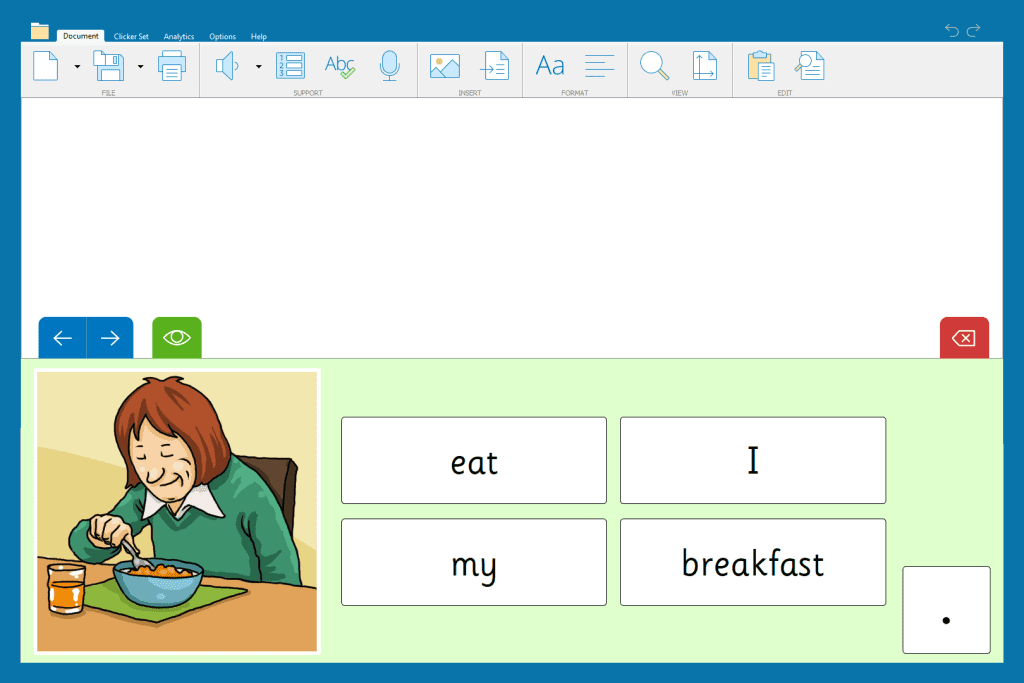
1. Sentence Sets are simple sentence building activities, working on constructing a specific sentence word by word. Sentence Sets are perfect for a student who needs support writing simple sentences with correct word order and punctuation.

2. The student may then move onto Connect Sets which are going to support your developing writers, providing clusters of words to help them build a coherent piece of text. It is still scaffolded writing but gives a greater choice of words.
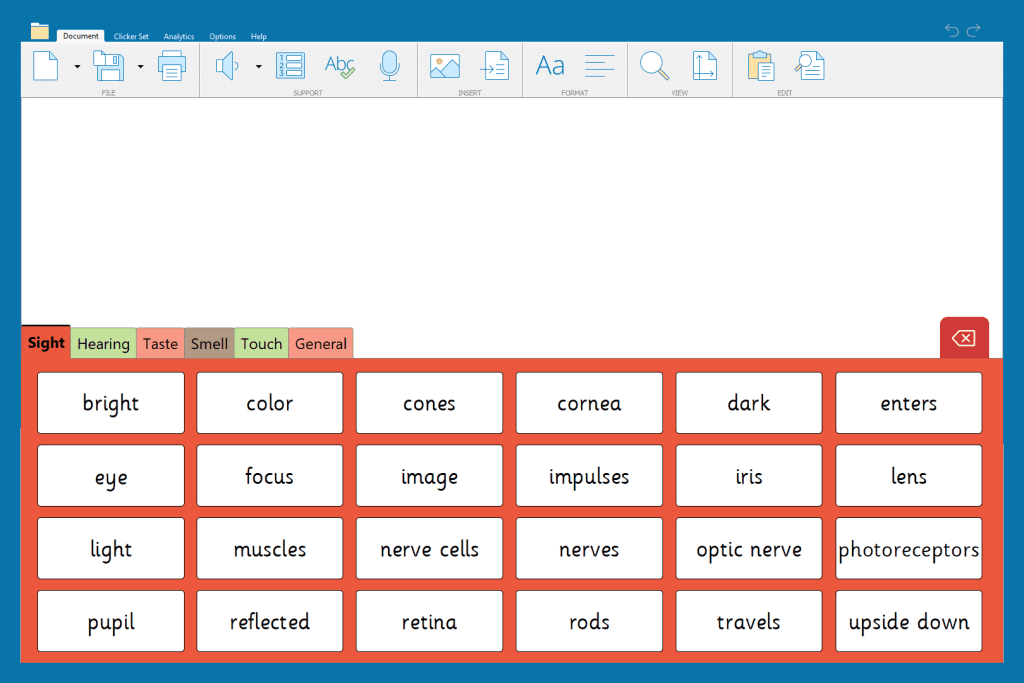
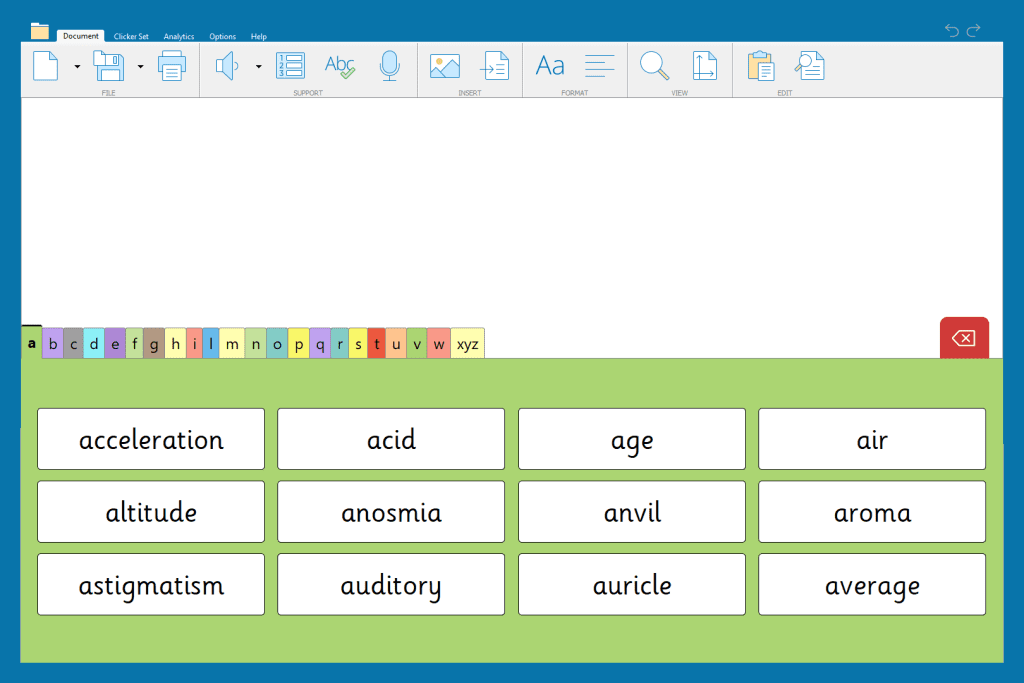
3. Finally, Word Banks are for more independent writers who can form sentences but need vocabulary support. Word Banks give students access to correctly spelled subject-specific vocabulary and provide support when using new vocabulary or difficult words. Word Banks can be organized into topic tabs to help structure a piece of writing or arranged alphabetically to support spelling.
To use the flowchart in your school, download it here.
Clicker’s intuitive word processor, including spell checker, Predictor, and Voice Notes, can be used alongside Clicker’s writing grids to transform a student’s daily writing challenges into achievable targets.
To view our bank of ready-made writing grids, visit LearningGrids. If you would like to edit or create your own writing grids, watch our tutorials.
If you have any questions, contact our Customer Experience team by phone at 203 221 2697 or by email at training@cricksoft.com.
Within a school setting, there are several ways to gather students’ views, feelings, and wishes.
One way to collect this information is through student voice. Student voice may be used to gather a range of ideas about a particular subject, to find out their opinion on a learning experience, or to complete a student’s learning plan.
Clicker Talk Sets are a great resource for this as they offer an alternative way to record for those who struggle to express their ideas or feelings in writing.
Talk Sets enable students to verbally record information and thoughts using picture prompts or verbal cues, developing their oral communication and listening skills.


Students can select a picture and then use the microphone to record their ideas, opinions, or answers.

Clicker Boards are another effective way to record student voice. Adding Voice Notes along with a text cell allows students to share their thoughts and ideas either orally or in a written format. With both Talk Sets and Clicker Boards, students can re-record as many times as they need to which is great for those who lack confidence or students who are learning English as an additional language. You can also use your own pictures as visual clues for students.

By giving them a voice, students are helped to feel safe to express their views and, as a result, they feel valued and listened to. Watch our Talk Set and Clicker Board tutorials to find out how to edit sets from LearningGrids or how to quickly create your own from scratch!
Word Banks are also a great writing resource which can be used to support student voice. You can create tabs to support the structure of an answer as well as to provide prompts.
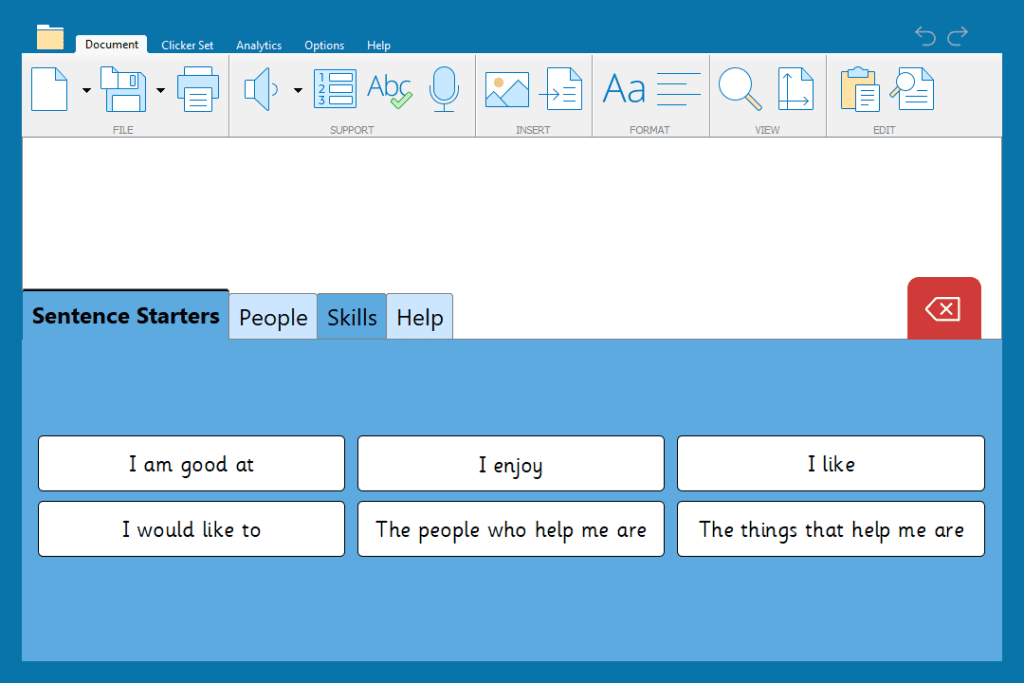
There are hundreds of free ready-made Word Banks available on LearningGrids, and it is quick and easy to edit them to add your own vocabulary. In this example, there is a sentence starter tab to support the beginning of the response and then subsequent tabs to help the students build their sentence.
Watch our tutorial for more support on how to create or edit a Word Bank from LearningGrids.
Providing students with a voice and giving them an opportunity to play an active role in the decisions made within the school positively affects their learning and well-being. To explore other ways that you could be using Clicker to support teaching, learning, and well-being across your school, contact our Customer Experience team at 203 221 2697 or email training@cricksoft.com.